CamboFest and the Making of Cambodia’s First International Film Festival After the Khmer Rouge
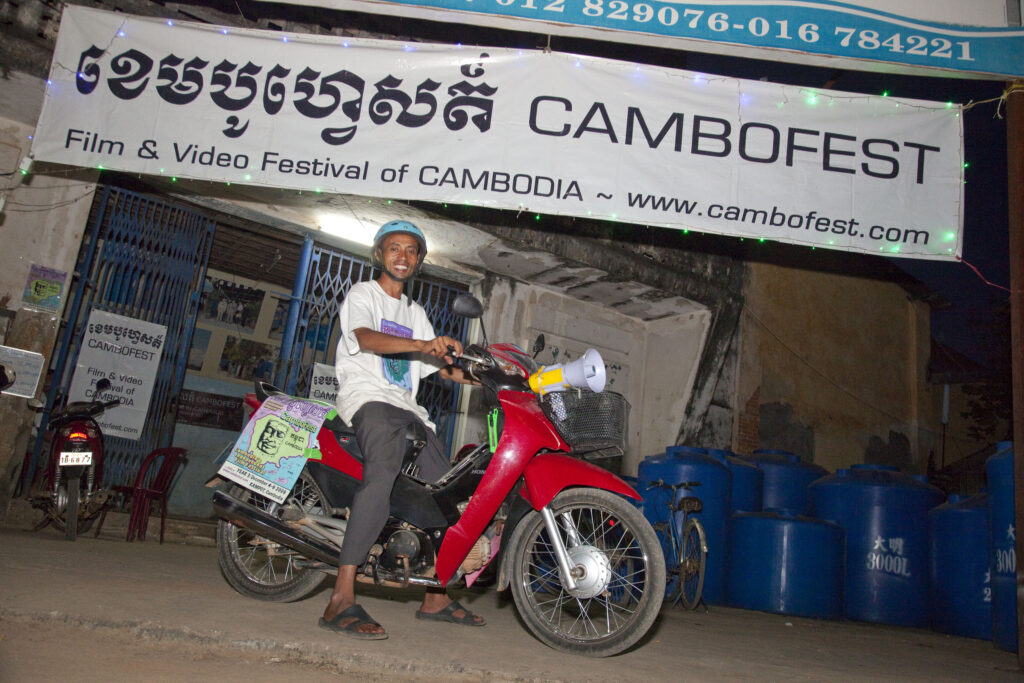
Key facts
- Festival: CamboFest, Cambodia Film Festival
- Founded: 2007 (Buddhist Year 2550)
- Founder: Jason Rosette, under Camerado; co-organized with Phun Sokunthearith, Suong Sambath, Tieng Ratha, and Narith Hoo
- Status: Cambodia’s first internationally recognized film festival
- Location: Phnom Penh, Siem Reap, Kampot, New York City
- Best Known For: Being Cambodia’s First Internationally Recognized Recurring Film Festival Event After the Khmer Rouge Regime
CamboFest Timeline
2007 — First edition, Phnom Penh & Siem Reap
2009 — Third edition; revival of the Royal Cinema in Kampot
2010 — Cambodia International Film Festival launches
2011 — Fourth Edition; H.M. KIng Father Sihanouk thanks CamboFest for reviving cinema culture in Cambodia; CamboFest traveling edition reaches Anthology Film Archives, New York
2026 — CamboFest active in online formats; remains dormant / in hibernation for live screenings
Introduction
(Overview from Jason Rosette) CamboFest launched in 2007, also known as Buddhist Year 2550, as Cambodia’s first internationally recognized film festival. Much of the country’s post-Khmer Rouge film culture remains thinly documented, and this piece lays out the essential foundation of CamboFest. A more detailed follow-up post will go deeper on specific threads.
What does “first international film festival” mean here?
The claim is specific: CamboFest was the first Cambodian film festival in this period to operate as an independent, internationally oriented event with an open submission process and a public screening program. Cambodia had earlier film screenings, cultural programs, embassy events, and other cinema-related activities. The claim is not that CamboFest was the first time films from outside Cambodia were ever shown in the country.
When Did Cambodia’s First International Film Festival Take Place?
CamboFest held its first edition in 2007 (2550). The French and European-funded Cambodia International Film Festival (CIFF) did not hold its inaugural edition until October 2010, three years later.
CamboFest was an independent, indie film festival…it wasn’t a development project, not aligned with any state agency. At the time, Cambodia’s government had no regular, annual film festivals of its own. What existed were sporadic, embassy-related screening events – a Japanese film series at the Japanese embassy, for instance, or screenings at the French Cultural Center – each fractured along its own state sponsorship line. There was nothing resembling the classic film festival format built on an open call for submissions.
How CamboFest Operated as a Genuine Film Festival
The distinction matters because CamboFest was not simply a branded series of invited screenings. Its first edition used an international submission call, published submission information, accepted films from filmmakers outside Cambodia, and built screening permission into the submission process itself. A film festival, in the classic sense, is built through direct curation plus an open call. Even Sundance does not simply slot in favorites without a submission process. That does not mean politics and favorites never factor in, but the structure runs on submitted content, alongside curated or retrospective strands for classics.
With CamboFest’s first edition, setting up a genuine open call mattered for its own sake: it made the launch more exciting, since filmmakers around the world could watch a new festival appear in Cambodia and want to be part of it. The screening dates were preceded by a submission period, a website announcement, press coverage, and posts on international film festival forums. That structure is central to understanding what “first international film festival” means in this context.
Why Did CamboFest Matter After the Khmer Rouge Era?
Cambodia had no regular international film festival culture after the Khmer Rouge era ended. Many cinema houses were destroyed outright, and IP (Intellectual Property) frameworks were totally destroyed. CamboFest was founded to help revive a legitimate cinema industry and to spark a movie-going culture in the country.
In 2007, a few standalone cinemas from the golden era were still operating, the Lux Cinema in Phnom Penh among them, mostly screening local ghost movies or slapstick comedies to houses that were sometimes surprisingly full. Those venues were later replaced by multiplexes showing local films. But there was no international film festival.
At the time, I was studying for a master’s degree in international development at the Royal University of Phnom Penh, while also holding a BFA from NYU, teaching, and producing media for various NGOs and private clients. It occurred to me that there was no independent film festival here, nothing where any filmmaker could submit and get a shot at screening their work. I didn’t know yet all the government-side permission requirements involved – that anything screened in Cambodia has to be reviewed and approved. I was just thinking about the gap, and the need, and so I launched it.
I was always planning something acceptable to a general audience, not an underground festival for instance. Underground fests tend to carry content that would be genuinely challenging in this environment. I built in programs and strands meant to support the sector’s development directly: animation, family-friendly films, social issue films. Getting that going mattered. Nobody else was running a film festival, and arguably only an agile, independent entity like we were could have been first at that point, since none of the usual development-agency apparatus was in place to do it.
The Institutional Landscape Around Cambodian Film Culture
Most moviegoers and casual festival-goers assume a film festival simply ‘appears’: someone has an idea, screens some films, and that’s that. What is much less visible is the institutional and cultural-policy apparatus that sits behind some of the festivals people take for granted.
I later learned that French and EU cultural actors were active, and arguably dominant or possessive, over Cambodia’s media and film sector. I didn’t know that at the time we launched CamboFest, so in retrospect, what I was doing was walking into territory they considered their own as a sort of mission civilisatrice.
Cedric Eloy, one of the first directors of the Cambodia International Film Festival, was closely associated with French institutional cultural networks. Eloy – whose background is rooted in French administrative and international business management training – arrived in Cambodia in 2009 and was installed as the International Advisor/Director of the newly created Cambodia Film Commission (CFC).
The CFC was not a grassroots Cambodian initiative; it was an organization explicitly established with funding from Film France in cooperation with the French development agency (AFD). The CFC had set up shop right across the street from the actual Cambodian government cinema office, the Department of Cinema and Cultural Diffusion. I didn’t realize it at the time, but this arrangement echoed the old French colonial system called the ‘shadow bureau’. In French political theory, this setup was officially known as a dédoublement administratif
My colleague Dr. Raymond (Ray) Leos, then Dean of the Faculty of Communication and Media Arts at Paññāsāstra University of Cambodia (PUC) used to joke about Cedric being a French government employee, noting Eloy’s institutional affiliation directly.
I can’t trace every euro of CIFF’s funding on a granular level, but an independent festival like CamboFest is self-funded through sponsors, donations, and submission fees, with operational costs kept low and tickets sold where possible. In Cambodia, that carried real obstacles; selling tickets technically required registering a for-profit company, and the development sector there has conditioned audiences to expect many cultural events for free, so a festival suffers if admission isn’t free or very cheap.
During a 2009 global restructuring under French President Nicolas Sarkozy, France forcibly rebranded its cultural center in Phnom Penh into the Institut Français du Cambodge as a defensive reaction to the rapid decline of French influence against rising English and Chinese dominance. This institutional pivot triggered an aggressive cultural posture by flooding Cambodia with French state-directed arts funding.
Anyway, the 2010 date for CIFF’s launch matters. It correlates with the broader push in that period by French and EU entities to reassert cultural soft power in Cambodia through institutional channels. While these development-backed initiatives brought scale to the sector, they were heavily intertwined with French foreign cultural policy – a geopolitical dynamic that remains highly relevant today as China increasingly edges out French and European soft power in the region.
By contrast, CamboFest was designed from the ground up to be neutral, multipolar, egalitarian, and independent. We were not built to serve any single nation’s soft-power agenda, although we did receive and appreciate US Embassy support in the form of loaned equipment. and materials to build a large indoor screen. This neutrality was reflected in our programming; winners from CamboFest came all over the world, from Cambodia, France, the UK, the US, Germany, Brazil, and many other places.
Attempts at Inclusion and Institutional Rebuffs
Our independent stance meant that our door was explicitly open to the French-aligned institutions as well. We wanted to build a collaborative, inclusive Cambodian cinema community. For years, stretching back to 2005, I made repeated efforts to involve Rithy Panh – Cambodia’s most prominent filmmaker and a central figure in the French cultural network via the Bophana Center – in CamboFest.
Despite our open invitations, these outreach efforts were repeatedly rebuffed. The institutional faction apparently had no interest in participating in a festival they did not control; this exclusionary approach is clearly captured in our archival correspondence.
For instance, in a 2008 email from Sabine Didier at the Bophana Center, and my subsequent 2011 follow-up with Cedric Eloy, it is documented that Panh explicitly declined to participate, despite our ongoing efforts to spark a meaningful dialogue:
On Aug 17, 2011, at 3:13 PM, Jason Rosette / CAMERADO wrote:
Jason Rosette / CAMERADO <jroxxxxx@gmail.com>
to:
Cedric ELOY – CFC <cedricxxxxx@cambodia-cfc.org>,
KIM Sophea <sophexxxxx@cambodia-cfc.org>
Sophea and Cedric:
Apologies, I misspoke before; it was not Aurolie who informed me previously re: Rithy Panh declining to participate in CamboFest some time ago, it was Sabine (see below)
Anyway, we had undertaken outreach to him quite a few times since 2005, so as you can see I’ve long attempted to involve other notable Cambodian media practitioners in a ‘meaningful discussion’ regarding any media efforts.
The door is still open, regarding CamboFest and other projects, but our outreach capacity is currently being applied elsewhere.
Hope all is well! am trying to wrangle a decent team to undertake Freedom deal in Cambodia if we can shoot it there, I sent some folks your way a couple weeks ago…
All the Best
Jason
Begin forwarded message:
Date: Thu, 31 Jul 2008 08:56:31 +0700
From: Sabine Didier <sabine.dxxxxx@bophana.org>
To: jason rosette <jroxxxxx@gmail.com>
Cc: Gaetan Crespel <gaetan.cxxxxx@bophana.org>
Subject: about CamboFest
Hello Jason,
Rithy Panh had confirmed that he wouldn’t participate to the Film and
Video Festival.
The only movie produced by Bophana Prod is “L’absence” Mathieu Peng. You
can see this movie in Bophana Center if you want….. .
As I’m leaving soon from Cambodia, you should contact my colleague,
Gaetan Crespel, about this issue.
Thanks.
Regards
Sabine
This exchange illustrates a crucial historical point: CamboFest did not operate in a vacuum by choice. We tried to cross the aisle to include the institutional, French-backed filmmakers in Cambodia’s first international film festival. But we were met with closed doors by the very same network that would later launch CIFF and attempt to write CamboFest out of history entirely.
What Were CamboFest’s Documented Firsts?
Beyond being the first internationally recognized film festival in the country, CamboFest set several other benchmarks for the sector:
- Explicit Film Clearance: Getting explicit clearance from every filmmaker was itself a first for Cambodian film exhibition. This did not mean just getting approval from the Cambodian Ministry (*this is mandatory for any publicly screened movie in Cambodia.) This meant getting permissions from every single rights holder as well. The prevailing model before CamboFest, which is a model some venues still regrettably use, was informal DVD and lounge-style screening: grab a disc, show it, no clearance. CamboFest built permission directly into the submission mechanism itself.
- The Golden Waterbuffalo Trophy: CamboFest awarded the ‘Grabay Meas’ (Golden Waterbuffalo) trophy to its winners, offering a tangible, culturally resonant symbol of achievement for international and local filmmakers alike.
- Early Online Streaming: During the 2007 and 2008 editions, CamboFest utilized a dedicated, YouTube-style online video portal to feature films called CamboTube. In an era where the digital divide was vast and broadband internet bandwidth in Cambodia was incredibly limited, this was a highly forward-thinking digital first.
- Historic Premieres: CamboFest presented the Cambodian premiere of Robert Flaherty’s Nanook of the North, with live Khmer narration, 88 years after the film’s original 1922 release, screened with permission from the Flaherty estate / Robert Flaherty Film Seminar.
- The Royal Cinema Revival: In 2009, for the third edition, we located and revived the vintage Royal Cinema in Kampot, built in the 1950s, destroyed during the civil war, rebuilt afterward, and operated as a working cinema until around the late 1980s. I stayed in touch with the cinema owner’s family, and I’m still in contact with them today. We secured a powerful projector on loan from the US Embassy, installed a new screen, and ran a fully digital throughput.
- Traveling International Edition: CamboFest launched the first international traveling edition of a Cambodian film festival in 2011, with its first stop in New York City at Anthology Film Archives, at the invitation of Barney Oldfield, who ran the New Filmmakers strand there.
The transition to proper digital throughput and licensed exhibition drew real pushback from practitioners uncomfortable with the attention drawn to intellectual property, and movie pirates objected vehemently.
How the Ministry Responded When CamboFest’s Standing Was Challenged
CamboFest’s position was not always uncontested by the new European-backed institutional arrivals. After CIFF’s launch in 2011, Cedric Eloy sent me an email out of the blue, stating that the Ministry had said CamboFest no longer had permission to operate in Cambodia.
———- Forwarded message ———-
From: Cedric ELOY – CFC <cedricxxxxx@cambodia-cfc.org>
Date: Thu, Aug 18, 2011 at 1:22 AM
Subject: Re: Correction ~ Fw: about CamboFest
To: Jason Rosette / CAMERADO <jrxxxxx@gmail.com>
Hi Jason,
Thank you for the info.
We had a meeting with the Ministry of Culture when they told us that CAMBOFEST was no longer authorized to operate in Cambodia.
Did you get any formal information regarding this ?
We did not get any feedback from the young cambodian you came with last time. Dara (CFC) left his name card but he never got back to us. If he wants to be contacted for jobs, he should come and get registered.
Best.
Cedric
It made no sense to me that a foreign government stakeholder would be preempting any official Cambodian government communication about such a thing; so I then contacted Sin Chan Saya, the Director of the Department of Cinema and Cultural Diffusion under the Ministry of Culture and Fine Arts.
The Director directly contradicted Eloy’s claim, confirmed continued Ministry support, and encouraged CamboFest to continue.
—– Forwarded Message —–
From: Chansaya Sin <chansaxxxxx@ymail.com>
To: The CamboFest Team <info@cambofest.com>
Sent:
Subject: Re: CamboFest
Dear Jason,
The Cinema and Cultural Diffusion Department will support
you and want you to involve in the next CamboFest film festival.
I want to meet you as soon as possible.Recently,We are preparing to
International Film Festival at beginning December 2011.
Best Regards,
Sin Chan Saya
Director of
Department of Cinema and Cultural Diffusion
Mobile: (855) 12 864 xxx
(*notably, the Director and his department were planning their own new film festival at this time as well)
The correspondence speaks for itself. CamboFest continued operating with the Ministry’s explicit support for at least another year following that exchange.
In my own assessment, this incident connects directly to the broader institutional dynamics in the sector at the time. I remain unsure why a more collaborative approach was not taken, since CamboFest’s priority as Cambodia’s first festival was already established well before CIFF launched.
Why Getting This Timeline Right Matters
An accurate record of Cambodia’s film festival history matters for the sector as a whole, not just for one festival’s reputation. As more international attention turns to Cambodian cinema, an accurate baseline helps researchers, journalists, and future festival organizers build on solid ground. It is also simply a matter of historical accuracy.
CamboFest was launched by me, an independent producer working part-time as a teacher and a graduate student. The Cambodia International Film Festival was launched with the backing of a much larger institutional apparatus. The difference in funding, scale, and publicity profile is enormous. That does not erase CamboFest, but there is a real risk of it being effectively erased if the public record begins and ends with later, better-resourced events.
The erasure of this history is actively happening. As of late 2026, CIFF’s own public-facing history, PR releases, and retrospective interviews consistently trace the “inception” of the Cambodian festival scene back to their own launch in 2010. They systematically omit any mention of CamboFest or earlier independent efforts, effectively attempting to rewrite the country’s cinematic timeline so that it begins with a French-funded enterprise.
While I am flattered if the CIFF was inspired by our festival’s launch, it would be appropriate, and historically accurate, for them to list the prior events, like ours, which helped pave the way for them. A more collaborative posture towards our effort could have made a great deal of difference, and would have been easy to achieve.
History and facts do not always make for a comfortable or easy narrative, but the timeline is what it is: CamboFest came first, and the Cambodia International Film Festival followed three years later.
Who Founded CamboFest?
CamboFest was founded by Jason Rosette, (me) a filmmaker, producer, and educator who has worked in the ASEAN region since 2005. Numerous Cambodian colleagues, including Phun Sokunthearith, Tieng Ratha, Suong Sambath, and Narith Hoo, were instrumental co-organizers. I hold a BFA in film and television production from NYU Tisch and a master’s degree in international development studies from the Royal University of Phnom Penh, the program I was in when the idea for CamboFest first took shape.
Where CamboFest and Cambodia’s Exhibition Sector Stand Today
CamboFest is effectively in hibernation as of September 2026, except for an online video component; it’s still too challenging to gainfully undertake a private sector, IP friendly independent film festival in the current Cambodian environment.
Today, gray-area and pirate exhibition still flourishes in Phnom Penh’s independent and arthouse sector – the very audience demographic that typically forms the lifeblood of an indie film festival. Compounding this challenge is the fact that heavily subsidized institutional events, such as those at CIFF or the German-sponsored Meta House – offer free admission for their screenings. The combination of rampant unlicensed exhibition and free institutional festivals creates a severe market distortion. It actively skews consumer expectations, effectively training local audiences to expect independent cinema for free.
Hollywood films have largely been legitimized through territory deals with major cinema chains, but the arthouse and repertory sector, including older Hollywood titles from the 90s and 2000s, remains largely unlicensed.
By comparison, House Samyan in Bangkok is an arthouse complex that licenses every film it screens properly, with moviegoers paying roughly 160 Thai baht (approximately US$4.50–5 at recent rates). That audience has been trained to expect to pay for quality projection and proper seating, something that remains close to impossible in Phnom Penh’s current exhibition environment outside of one-off boutique screenings.
If anything, I’d say the environment now is at least as difficult as it was in 2007, nearly twenty years ago, which I attribute largely to exhibitors screening and advertising unlicensed content, and institutionalized ‘free’ art house screenings.
CamboFest ran for four years (with documented editions in 2007, 2009, and activity through ~2011), facing both the unresolved IP and piracy problem in local exhibition and pressure from a far better-funded and aggressive French and EU-backed contingent. Without ongoing funding to absorb losses year after year, continuing wasn’t sustainable. I describe CamboFest’s legacy as that of a vanguard pioneer.
Primary Documentation
The historical record for CamboFest includes festival programs, submission announcements, press coverage, correspondence with filmmakers and Cambodian cultural officials, exhibition records, and documentation from the 2009 Kampot and 2011 New York editions. Many many emails, documents, and correspondences remain available in archive format for further study at a future date. Where this article makes claims about disputed events, the underlying correspondences can be reproduced or linked where appropriate.
Learn more about CamboFest at www.cambofest.com